
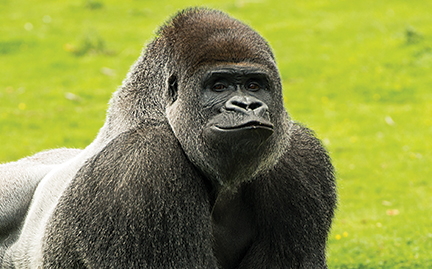
GORILLA
Gorillas are ground-dwelling, predominantly herbivorous apes that inhabit the forest of central Sub-Saharan Africa. The genus Gorilla is divided into two species: the eastern gorillas and the western gorillas (both critically endangered), and either four or five subspecies. They are the largest living primates. The DNA of gorillas is highly similar to that of humans, from 95 to 99% depending on what is included, and they are the next closest living relatives to humans after the chimpanzees and bonobos
A gorilla's day is divided between rest periods and travel or feeding periods. Diets differ between and within species. Mountain gorillas mostly eat foliage, such as leaves, stems, pith, and shoots, while fruit makes up a very small part of their diets. Mountain gorilla food is widely distributed and neither individuals nor groups have to compete with one another. Their home ranges vary from 3 to 15 km2 (1.16 to 5.79 mi2), and their movements range around 500 m (0.31 mi) or less on an average day. Despite eating a few species in each habitat, mountain gorillas have flexible diets and can live in a variety of habitats
Gorillas rarely drink water "because they consume succulent vegetation that is comprised of almost half water as well as morning dew
WHERE WILL YOU FIND THEM
Mountain gorillas live in Rwanda, Uganda and the Democratic Republic of the Congo, on green, volcanic mountains. Lowland gorillas live in the forests of central and western Africa in Equatorial Guinea, Angola, Cameroon, the Central African Republic, Congo, Gabon and the Democratic Republic of the Congo.